

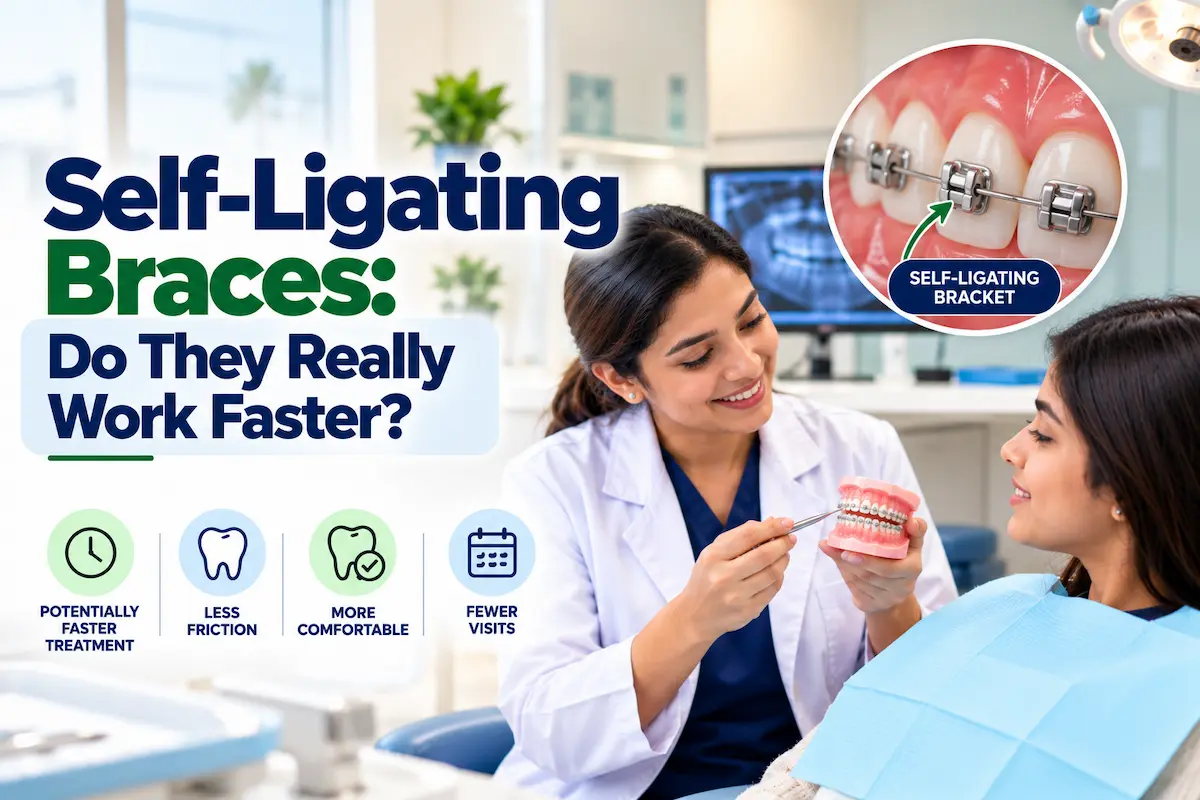
If you have searched for braces online in the last few months, you have probably seen the pitch: “faster treatment, less pain, fewer visits”. It usually comes attached to self-ligating braces, sometimes under a brand name like Damon. The pitch is persuasive, and the braces are also a bit more expensive, so it is worth asking a plain question before you pay the difference: what does the research actually show?
This guide explains how self-ligating braces work, the two main types, what clinical trials found about speed and pain, the real advantages, and what they cost in Kolkata.
What Are Self-Ligating Braces?
In regular braces, the wire sits in a slot on each bracket and is held there by a tiny elastic ring or a thin steel tie. That holding step is called ligation.
Self-ligating brackets skip the elastic ring. Each bracket has a small built-in clip or sliding door that closes over the wire and holds it in place. The idea is not new. The first self-ligating bracket patent goes back to 1933, and the Damon bracket, the name most patients in India recognise, was introduced in 1996.
From the outside they look much like normal braces. They come in metal and in clear or tooth-coloured versions.
Active vs Passive Self-Ligating Braces
Passive self-ligating
The door closes over the slot but does not press on the wire. The wire can slide with less friction. Damon brackets are the best-known passive design.
Active self-ligating
A spring clip presses against the wire, giving the orthodontist more direct control, especially in later stages. Examples include In-Ovation and SPEED brackets.
Which type is better depends on the movement your teeth need. Your orthodontist chooses based on your bite, not on the brand.
Are Self-Ligating Braces Faster or Less Painful?
This is where the marketing and the research part ways.
A multicentre randomised controlled trial in the UK compared a self-ligating bracket with a conventional bracket. Of 138 patients recruited, 135 completed treatment. Results published in The Angle Orthodontist showed:
| Outcome | Self-ligating | Conventional |
|---|---|---|
| Average treatment time | 25.12 months | 25.80 months |
| Average number of visits | 19.97 | 20.37 |
| Clinically meaningful difference? | No, for both measures | |
The second part of the same trial looked at pain. Patients’ reported pain showed no clinically significant difference between the two systems.
A literature review published in February 2026 in the Archive of Orofacial Data Science went through 36 studies from 2003 to 2023. It found no statistically significant difference between self-ligating and conventional brackets for treatment time, pain, root resorption or gum health. Some studies leaned slightly towards self-ligating, but the author concluded that the evidence is not enough to say either system is more efficient.
Real Advantages and Limits
That does not make self-ligating braces pointless. They have practical benefits that have nothing to do with speed:
- No elastic rings to stain. Regular braces use elastic ties that can pick up colour from tea and coffee. Self-ligating brackets do not need them, which is useful with clear brackets.
- Simpler wire changes. The orthodontist opens and closes the clip instead of replacing ties around every bracket.
- A tidier look. With no coloured or grey ties, the clear versions look cleaner from up close.
The limits are worth knowing too:
- Higher cost. At our clinic they cost noticeably more than conventional metal braces.
- Clips can fail. A clip or door can occasionally open or break and needs a repair visit.
- Elastics may still be needed. Many bite corrections still use rubber bands between the jaws, whatever the bracket type.
Self-Ligating Braces Cost in Kolkata
Indicative full-treatment costs at Teeth Care Multispeciality Dental Clinic:
| Brace Type | Indicative Full Treatment Cost |
|---|---|
| Metal braces (conventional) | INR 60,000 to 70,000 |
| Ceramic braces (conventional) | INR 65,000 to 75,000 |
| Damon metal (self-ligating) | INR 80,000 to 1,00,000 |
| Damon clear (self-ligating) | INR 95,000 to 1,30,000 |
Put simply, self-ligating metal costs roughly INR 20,000 to 30,000 more than conventional metal at our clinic. You are paying for convenience and appearance, not for a shorter treatment.
How to Decide
Self-ligating makes sense if
- You want clear brackets without ties that discolour
- The extra cost fits comfortably in your budget
- Your orthodontist recommends it for your type of movement
Conventional is fine if
- Your main goal is the result at a lower cost
- You were told self-ligating will halve your treatment time
- You do not mind changing ties at each visit
If someone promises you a much faster finish because of the bracket alone, ask them for the evidence. A specialist should be able to explain your plan in terms of your bite, not the bracket brand. Our article on orthodontist vs dentist explains why that training matters.
You can see every brace and aligner option we offer on our orthodontic treatment page, or compare with ceramic braces if appearance is your main concern. Our main clinic site also explains every option on its dental braces in Kolkata page.
References
- A multicenter randomized controlled trial to compare a self-ligating bracket with a conventional bracket in a UK population. Part 1: Treatment efficiency. The Angle Orthodontist, 86(1).
- Part 2: Pain perception. The Angle Orthodontist, 86(1).
- Heng S. Self-Ligating Versus Conventional Orthodontic Brackets: A Review of Treatment Efficiency and Adverse Effects. Archive of Orofacial Data Science, 2026.
- Self-ligating bracket. Wikipedia.
Frequently Asked Questions
Are Damon braces and self-ligating braces the same?
Damon is one brand of passive self-ligating bracket. All Damon braces are self-ligating, but not all self-ligating braces are Damon. Other systems use active clips.
Do self-ligating braces reduce treatment time?
Clinical trials have not shown a meaningful difference. A UK randomised trial found 25.12 months for self-ligating and 25.80 months for conventional brackets, which the authors judged clinically insignificant.
Are self-ligating braces less painful?
The same UK trial found no clinically significant difference in pain, and a 2026 review of 36 studies reached the same conclusion. Most people feel some soreness for a few days with any fixed braces.
How much do self-ligating braces cost in Kolkata?
At Teeth Care, indicative costs are INR 80,000 to 1,00,000 for Damon metal and INR 95,000 to 1,30,000 for Damon clear. Your exact figure is confirmed after examination.
Do I need fewer visits with self-ligating braces?
The UK trial recorded an average of 19.97 visits with self-ligating brackets and 20.37 with conventional ones, which is not a meaningful difference. Visit frequency depends on your treatment plan.
Can I get self-ligating braces as an adult?
Yes. Adults can have any type of fixed braces if their teeth and gums are healthy. Read our guide on adult orthodontic treatment in Kolkata for what to expect.
Also Read
Not Sure Which Braces Suit You?
Book an orthodontic consultation at any Teeth Care branch in Kolkata. We will explain the options that fit your bite and your budget.
Book an AppointmentCall +91 98315 26251Available at our Chinar Park, New Town, Ballygunge, Dunlop and Charnock branches. This article is for general information and does not replace a clinical examination.