

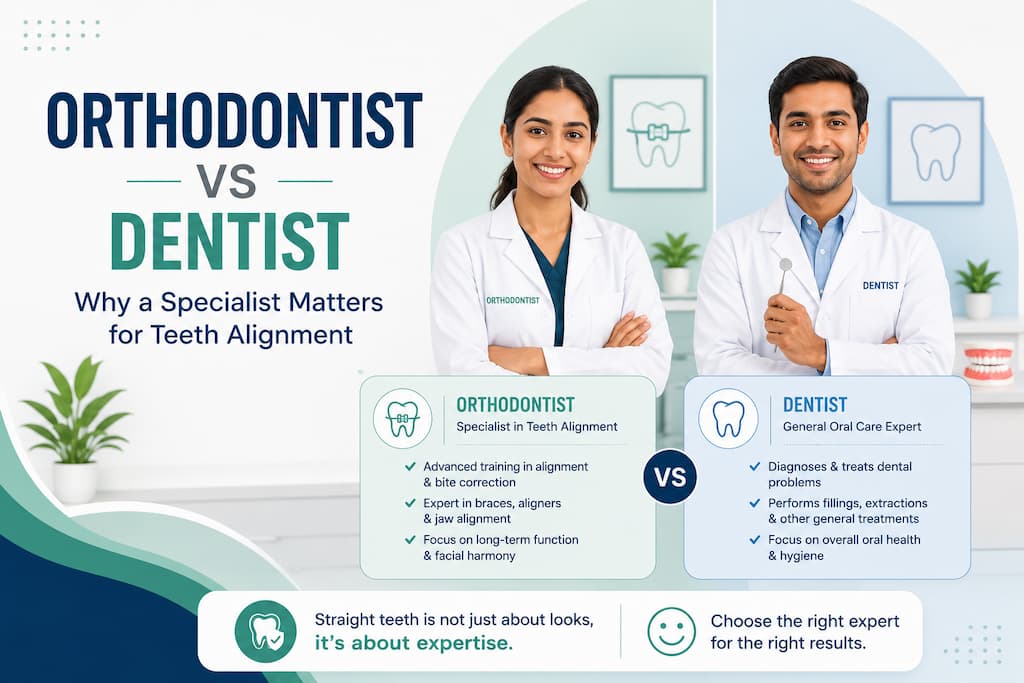
When you decide to straighten your teeth, one of the first choices you face is who should do it. Many general dentists in Kolkata offer braces and aligners, but that does not make them orthodontists. The difference matters more than most patients realise, especially for complex cases involving bite correction, jaw alignment, or treatment that spans 12 to 24 months.
This guide explains the actual difference between a dentist and an orthodontist, why specialist training leads to better outcomes, and what to look for when choosing your provider.
What Is the Difference Between a Dentist and an Orthodontist?
A dentist completes a 4 to 5 year Bachelor of Dental Surgery (BDS) degree. This covers general dental care: fillings, extractions, cleaning, root canals, and basic preventive treatment. Orthodontics is taught at the BDS level, but only as an overview, not as hands-on specialist training.
An orthodontist is a dentist who then completes an additional 3-year Master of Dental Surgery (MDS) specialising in Orthodontics and Dentofacial Orthopaedics. This training focuses entirely on tooth movement, jaw development, bite mechanics, and the biomechanics of different appliance systems.
In short: every orthodontist is a dentist, but not every dentist is an orthodontist. The additional 3 years of specialist training make a measurable difference in diagnosis accuracy, treatment planning, and handling complications.
The Training Gap: BDS vs MDS in Orthodontics
| Area | General Dentist (BDS) | Orthodontist (MDS Orthodontics) |
|---|---|---|
| Orthodontic training duration | A few weeks within a broader curriculum | 3 full years of dedicated study and clinical practice |
| Clinical cases treated during training | Minimal to none independently | Hundreds of supervised cases across all complexity levels |
| Biomechanics knowledge | Basic theory | Advanced wire bending, force systems, anchorage planning |
| Jaw growth and development | General overview | Deep understanding of cephalometric analysis and growth modification |
| Appliance systems mastered | Typically 1 to 2 (often only aligners) | Metal, ceramic, self-ligating, lingual, functional appliances, and aligners |
| Complication management | Limited experience | Trained to handle root resorption, anchorage loss, mid-treatment course corrections |
Side-by-Side: What You Get from Each
General Dentist for Orthodontics
- Can handle simple cases (mild crowding, minor spacing)
- May rely on aligner companies for treatment planning rather than designing the plan themselves
- Limited experience with complex bite correction
- May not have the tools or training to manage mid-treatment problems
- Often cannot offer the full range of appliance options
Specialist Orthodontist (MDS)
- Diagnoses root causes of misalignment, not just the visible symptoms
- Designs your treatment plan based on clinical analysis, not algorithm-generated suggestions
- Competent across all appliance types and recommends the right one for your case
- Trained to handle complications and course-correct when needed
- Understands jaw growth patterns for children and teens
When Does the Difference Matter Most?
For mild spacing or minor crowding with clear aligners, a general dentist with aligner training may deliver acceptable results. But the specialist advantage becomes critical when:
- Bite correction is needed (overbite, underbite, crossbite, open bite). Read our detailed guide on how orthodontics fixes bite problems.
- The case involves jaw discrepancy, not just crooked teeth.
- You are choosing between multiple appliance types and want an unbiased recommendation.
- Previous treatment has failed or relapsed, requiring retreatment.
- A child needs early evaluation to assess jaw growth and interceptive treatment timing.
- Other dental work is needed alongside alignment, such as dental implants or root canal treatment.
What to Check Before Choosing Your Provider
| Question to Ask | Why It Matters |
|---|---|
| Is the treating doctor an MDS in Orthodontics? | Confirms specialist qualification, not just a general BDS |
| How many orthodontic cases have they treated? | Experience matters, especially for complex cases |
| Do they offer all brace types or only aligners? | A provider who only offers one system may not recommend the best option for you |
| Will I receive a written treatment plan with costs before starting? | Transparency prevents surprises mid-treatment |
| Is the clinic multispeciality? | Coordination with other specialists (restorative, endodontic, prosthodontic) is often needed |
Our Consultant Orthodontist at Teeth Care Dental
At Teeth Care Multispeciality Dental Clinic, orthodontic treatment is led by Dr. Jeet Singh (BDS, MDS), a postgraduate-qualified Consultant Orthodontist. He is supported by Chief Dentist Dr. Sanket Chakraverty (BDS, MDS Prosthodontics and Implantology), ensuring every patient receives specialist-level care backed by a full multispeciality team of 22+ MDS specialists.
All brace types are available, from metal and ceramic to Damon self-ligating and clear aligners, and every treatment plan is designed by the orthodontist after clinical evaluation, not by an algorithm.
For a complete overview of braces types, pricing, and specialist credentials, visit our best dentist for braces in Kolkata page.
Can a general dentist legally do braces?
Yes, a registered BDS dentist can legally provide orthodontic treatment in India. However, legal permission and clinical competence are different. An MDS in Orthodontics includes 3 additional years of specialist training, which can be particularly valuable for diagnosis and complex cases.
Are orthodontists more expensive than general dentists?
Not necessarily. Cost depends mainly on the appliance type and case complexity rather than the provider’s qualification. At Teeth Care Dental, orthodontic treatment starts from ₹60,000 with EMI options. The key difference is specialist planning and treatment management.
What if my case is simple? Do I still need an orthodontist?
Specialist evaluation can still be beneficial for apparently simple cases. Mild crowding may sometimes be associated with an underlying bite problem that requires X-rays and cephalometric analysis. An orthodontist can identify these issues before treatment begins.
How do I verify if someone is actually an MDS Orthodontist?
You can ask to see their degree certificate or verify their professional registration with the relevant dental regulatory authority or State Dental Council. A qualified orthodontist should be able to explain their MDS training and professional background.
Does Teeth Care Dental have a specialist orthodontist at every branch?
Dr. Jeet Singh (BDS, MDS) serves as Consultant Orthodontist across all 5 Teeth Care branches in Kolkata. Orthodontic appointments are scheduled so that patients can be evaluated by the specialist regardless of which branch they visit.
Also Read
Get Specialist Orthodontic Care in Kolkata
Book a free consultation with our MDS Consultant Orthodontist at any of our 5 branches.
Book an Appointment Call +91 98315 26251