

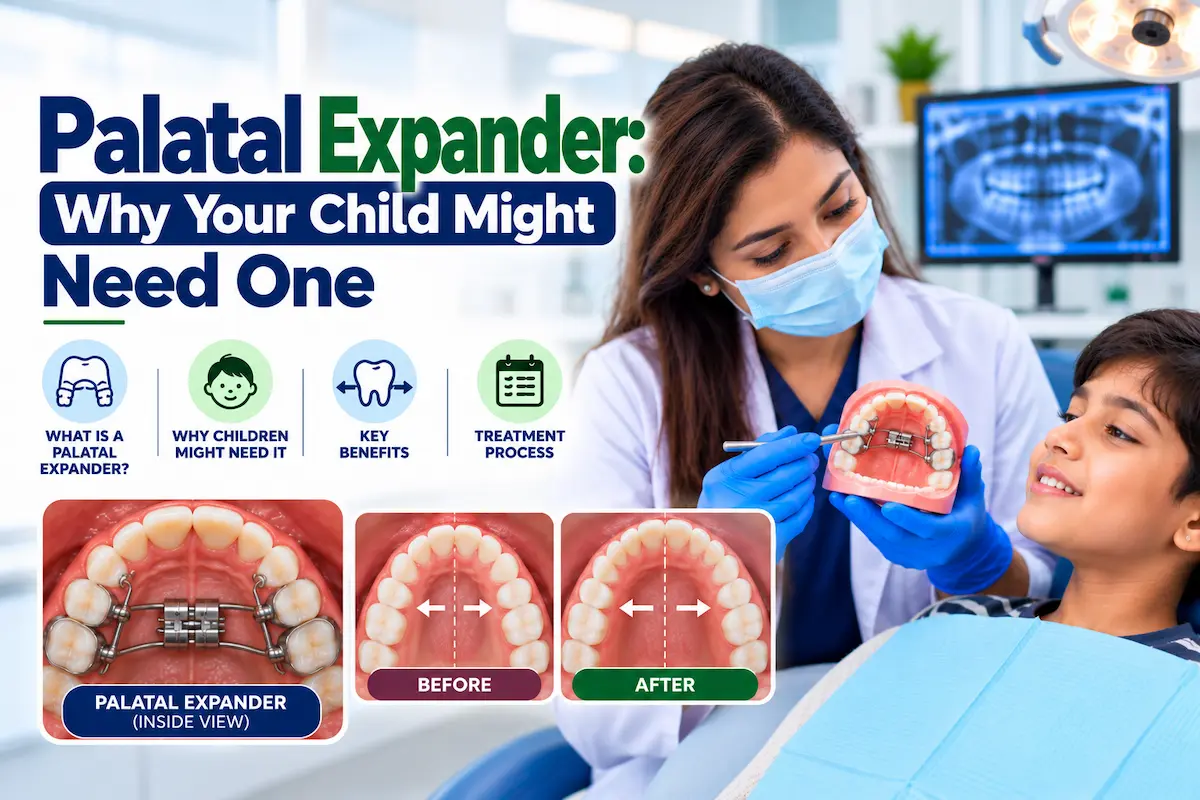
A parent sits in the orthodontist’s chair beside their nine-year-old and hears a phrase they have never heard before: “palatal expander”. Then comes the part that sounds alarming. A small screw in the roof of the child’s mouth, a key, and a parent turning it at home.
It sounds stranger than it is. A palatal expander is one of the most common appliances in children’s orthodontics, and it works with the way a child’s jaw is still growing. This guide explains what a palatal expander does, why the right age matters, what the weeks of treatment look like, and what options exist for teenagers and adults.
What Is a Palatal Expander?
A palatal expander is a custom-made appliance fixed to the upper back teeth. It has two halves joined by a small screw that sits under the roof of the mouth. Each time the screw is turned with a tiny key, the two halves move apart very slightly and press outward on the upper jaw.
The upper jaw is actually made of two halves joined down the middle by a seam called the midpalatal suture. In children, that seam has not fully fused. Steady pressure from the expander gently opens it, and new bone fills the space over the following months. The result is a wider upper jaw, not just tilted teeth. Because the turning happens over a few weeks rather than months, this approach is often called a rapid palatal expander or rapid maxillary expansion.
Why Would a Child Need a Palatal Expander?
The orthodontist usually recommends a palatal expander for one of two reasons:
- Crossbite. When the upper jaw is too narrow, some upper back teeth bite inside the lower teeth instead of outside them. Our main clinic site explains this and other bite problems in its guide to overbite, underbite and crossbite.
- Not enough space. A narrow upper arch can leave too little room for the permanent teeth that are still coming in.
An expander may be the only treatment a child needs, or it may be the first step before braces later. That decision usually comes out of an early check-up. Our guide on early orthodontic evaluation for children explains when that first visit should happen.
Why Age Matters for a Palatal Expander
Timing is the reason orthodontists talk about expanders in childhood. A review in the International Journal of Clinical Pediatric Dentistry notes that after puberty the two halves of the suture interlock more and more tightly, which makes separating them difficult.
Colgate’s guide on palate expanders makes the same point in plain words: expanders work best in children and preteens, whose palate bones have not fully fused. That is why an orthodontist may suggest one at eight or ten years old even if the child’s teeth do not look very crooked yet. Waiting can make the same correction harder.
How Palatal Expander Treatment Works, Step by Step
Records and fitting
The orthodontist takes impressions or scans, and the expander is made to fit your child’s teeth. At the fitting visit it is cemented to the upper back teeth.
Turning the key at home
A parent turns the screw with a small key, usually once or twice a day, exactly as the orthodontist directs. The pediatric dentistry review describes a common protocol of a quarter turn twice a day. Follow your own orthodontist’s schedule, not a general one.
Active expansion, usually a few weeks
The same review gives an active phase of about two to three weeks. The orthodontist checks progress at regular visits and tells you when to stop turning.
Holding phase, several months
The expander stays in place after the turning stops so new bone can fill the widened area. The review mentions about three months, and Colgate cites three to nine months depending on the case.
The Gap Between the Front Teeth
Most parents panic about this part, so it is worth knowing in advance. As the upper jaw widens, a gap often opens between the two upper front teeth. Colgate describes this gap as normal and a sign that the expander is working.
The pediatric dentistry review notes that this gap is expected to close on its own during the holding phase, and braces can close any remaining space later. It is temporary.
Eating, Cleaning and Comfort
What is normal
- Pressure in the teeth, or below the eyes and at the bridge of the nose, after turning
- Talking and eating feeling awkward for the first days
- A slight lisp or extra saliva at the start
- A gap opening between the front teeth
Foods to avoid
- Nuts, chikki and hard sweets
- Sticky toffee and chewing gum
- Ice cubes
- Chewing pencils or other objects
Food tends to collect around the expander, so brushing after meals matters. Colgate recommends brushing at least three times a day and using a water syringe to flush out food stuck under the appliance.
For pressure after turning, ask the orthodontist before giving any pain reliever, and which one suits your child’s age.
Palatal Expander for Adults and Older Teens
Because the suture tightens after puberty, a standard palatal expander does not work the same way in adults. Newer techniques can help in some cases. One is miniscrew-assisted rapid palatal expansion, often shortened to MARPE, where small screws anchored in the palate help push the halves apart.
A 2023 systematic review and meta-analysis in BMC Oral Health looked at MARPE in patients over 13.5 years old and reported a mean success rate of about 94%. The authors also noted some relapse over time, possible side effects, and very low overall quality of evidence. In other adult cases, expansion needs a surgical approach.
So if you are an adult with a narrow upper jaw, the answer depends on your own scans and bite. Our orthodontic team can assess what is realistic, and our guide on adult orthodontic treatment in Kolkata covers other options.
References
- Agarwal A, Mathur R. Maxillary Expansion. Int J Clin Pediatr Dent, 2010.
- Long-term efficacy and stability of miniscrew-assisted rapid palatal expansion in mid to late adolescents and adults. BMC Oral Health, 2023.
- Colgate India. What Is an Expander?
Frequently Asked Questions
What does a palatal expander do?
It widens the upper jaw by gently separating the two halves of the palate along the midline seam, which is still open in children. New bone then fills the space, leaving a wider upper arch.
What is the best age for a palatal expander?
Expanders work best in children and preteens, before the palate seam fuses. After puberty the seam interlocks more tightly and becomes harder to separate, so your orthodontist may suggest one before braces.
How long does a child wear a palatal expander?
Active turning usually lasts a few weeks, often about two to three. The expander then stays in for several months, commonly around three and up to nine, so the new bone can settle.
Is a palatal expander painful?
Most children feel pressure rather than pain, often in the teeth, under the eyes or at the bridge of the nose, especially after a turn. Ask your orthodontist before giving any pain reliever.
Why is there a gap between my child's front teeth?
The gap is a normal sign that the upper jaw is widening. It usually closes during the holding phase, and braces can close any space that remains.
Can adults get a palatal expander?
A standard expander works less well in adults because the palate seam has fused. Techniques such as miniscrew-assisted expansion or a surgical approach may be options, depending on your scans and bite.
Also Read
Has Your Child Been Advised an Expander?
Book an orthodontic consultation at any Teeth Care branch in Kolkata. We will check your child’s bite and explain whether an expander is needed and when.
Book an AppointmentCall +91 98315 26251Available at our Chinar Park, New Town, Ballygunge, Dunlop and Charnock branches. This article is for general information and does not replace a clinical examination.