


Root canal treatment in Kolkata in 2026 is painless and fast. TCMDC explains the real cost, the procedure step by step, sessions needed and recovery.

Dental Implants in Kolkata: Cost, Procedure and Timeline
Dental implants in Kolkata cost INR 25,000 to INR 60,000 per tooth. See the full procedure, realistic timeline, and how implants compare to bridges.

Cosmetic Dentistry in Kolkata: Treatments, Costs and Results
Cosmetic dentistry in Kolkata from INR 1,500. Compare whitening, veneers, bonding, gum contouring and crowns with real costs and longevity at TCMDC.

Retainers After Orthodontic Treatment: Types, Care, and Why They Matter
Getting your braces off or finishing your last aligner tray is a milestone. But it is not the end of your orthodontic journey. Without a retainer, your teeth will gradually shift back toward their original positions. This process is called relapse, and it can undo months or even years of treatment.
Retention is the most underrated part of orthodontic care. Patients invest significant time and money in alignment, then lose ground because they did not wear their retainer consistently. This guide explains why retainers matter, which types are available, how long you need to wear them, and how to care for them properly.
Why Teeth Shift After Orthodontic Treatment
Teeth are not set in concrete. They sit in bone surrounded by ligaments and soft tissue fibres that have “memory.” During orthodontic treatment, these fibres stretch as teeth move. After the braces or aligners are removed, the fibres try to pull teeth back toward their original positions.
Additionally, teeth naturally shift throughout life due to normal ageing, gum health changes, and the forces of chewing and speaking. This is true for everyone, whether or not they have had orthodontic treatment. A retainer holds your teeth in their corrected position while the bone and tissue remodel around them and stabilise.
The risk is highest in the first 12 months. Immediately after treatment, the bone around your teeth is still soft and remodelling. This is when teeth are most prone to shifting. Wearing your retainer consistently during this period is critical.
Types of Retainers
At Teeth Care Multispeciality Dental Clinic, we prescribe the retainer type best suited to your case. There are three main options:
Type 1
Hawley Retainer (Wire and Acrylic)
The classic retainer. A metal wire runs across the front of your teeth, attached to an acrylic plate that sits against the roof of your mouth (upper) or behind your lower teeth (lower). It is custom-made from an impression of your teeth.
Pros: Durable, adjustable, allows natural tooth settling. Cons: More visible than other options, can feel bulky initially.
Type 2
Clear (Essix) Retainer
A transparent, vacuum-formed tray that fits snugly over your teeth, similar to a clear aligner. It is nearly invisible when worn.
Pros: Discreet, comfortable, easy to wear. Cons: Less durable than Hawley (may need replacing every 1 to 2 years), does not allow teeth to settle as naturally, can crack if clenched.
Type 3
Fixed (Bonded) Retainer
A thin wire bonded to the back surface of your front teeth (usually the lower 6 teeth). It stays in permanently and is invisible from the outside.
Pros: No compliance required (always working), invisible. Cons: Requires careful cleaning around the wire (floss threaders or interdental brushes recommended), can debond and needs periodic checks.
Fixed vs Removable: Which Is Better?
| Factor | Removable Retainer (Hawley / Clear) | Fixed Retainer (Bonded Wire) |
|---|---|---|
| Visibility | Clear retainer is nearly invisible; Hawley is slightly visible | Completely invisible (behind teeth) |
| Compliance | Requires discipline to wear consistently | No compliance needed (always in place) |
| Oral hygiene | Easy (remove to brush and floss normally) | Requires extra effort to clean around wire |
| Durability | Clear: 1 to 2 years. Hawley: 5 to 10 years | Can last many years but may debond |
| Maintenance | Replace if lost, cracked, or worn | Periodic dental check to confirm bond is intact |
| Best for | Disciplined patients who prefer flexibility | Patients who may not wear a removable retainer consistently |
Many orthodontists, including our team at Teeth Care, use a combination approach: a fixed retainer on the lower teeth (where relapse is most common) plus a removable retainer for the upper teeth. Your orthodontist will recommend the right combination based on your specific case.
How Long Do You Need to Wear a Retainer?
The short answer: as long as you want your teeth to stay straight.
| Phase | Duration | Wear Schedule |
|---|---|---|
| Phase 1: Full-time wear | First 4 to 6 months after treatment | All day and night, removing only for eating and cleaning |
| Phase 2: Night-time wear | 6 months to 2 years | Every night while sleeping |
| Phase 3: Long-term maintenance | Ongoing (ideally lifetime) | 3 to 5 nights per week, or as advised by your orthodontist |
For fixed retainers, there is no wear schedule because the wire is always in place. Most orthodontists recommend keeping a fixed retainer for at least 5 years, and many patients choose to keep them indefinitely.
A good rule of thumb: If your retainer still fits comfortably, keep wearing it. If it feels tight when you put it back in after skipping a few nights, your teeth have already started to shift. Resume wearing it immediately and contact your orthodontist if the tightness does not resolve in a few days.
Retainer Care and Maintenance
For removable retainers
- Clean daily. Brush your retainer gently with a soft toothbrush and cool water every time you remove it. Do not use toothpaste (it is abrasive and can scratch clear retainers).
- Soak weekly. Use a retainer cleaning tablet or a mild denture cleaner once a week to remove buildup.
- Store safely. Always keep your retainer in its case when not wearing it. Wrapping it in a tissue is the most common way retainers get lost or thrown away.
- Keep away from heat. Hot water, direct sunlight, and car dashboards can warp clear retainers permanently.
- Bring it to appointments. Your orthodontist can check the fit and condition during regular dental visits.
For fixed retainers
- Use floss threaders or interdental brushes. The bonded wire makes regular flossing difficult. A floss threader allows you to clean between teeth and around the wire.
- Schedule regular cleaning visits. Professional teeth cleaning every 3 to 4 months is recommended to prevent tartar buildup around the bonded wire.
- Check for debonding. If you feel the wire loosening or a piece of it lifting, contact your orthodontist promptly. A partially debonded retainer is worse than no retainer because it can allow teeth to shift unevenly.
What Happens If You Stop Wearing Your Retainer?
Relapse. It is that straightforward. The degree of relapse depends on how long you go without your retainer and the original severity of your misalignment. Common outcomes include:
- Lower front teeth crowding again (the most common relapse)
- Gaps reopening, especially if you had spacing issues
- Bite shifting back toward its original position
- Retainer no longer fitting (meaning new impressions and a new retainer are needed)
If relapse has already occurred, the good news is it can be corrected. Depending on the severity, options range from a new set of retainers, to short-term clear aligner treatment, to a second round of fixed braces. Prevention through consistent retainer wear is always easier and less expensive than retreatment.
Frequently Asked Questions
Is age 7 too young for an orthodontic check-up?
No. The American Association of Orthodontists recommends a first orthodontic evaluation by age 7. At this age, the orthodontist can assess jaw growth, tooth development, and available space. Most children do not need treatment immediately. The visit is primarily for screening and monitoring.
Will my child definitely need braces after an early evaluation?
Not necessarily. Many children only need periodic monitoring as their teeth and jaws develop. An early evaluation helps determine whether treatment is needed now or whether development is progressing normally.
What is the difference between Phase 1 and Phase 2 treatment?
No. Forcing an old retainer onto shifted teeth can cause pain, damage the retainer, or move teeth incorrectly. If significant shifting has occurred, you need a professional assessment. Your orthodontist may recommend short-term clear aligner treatment to correct the relapse before fitting a new retainer.
My child still sucks their thumb. Should I be worried?
Replacement retainer costs are a fraction of the original orthodontic treatment cost. Contact your nearest Teeth Care branch for current pricing. Investing in a replacement retainer is always more affordable than retreatment for relapsed teeth.
Does early treatment cost more than just waiting for braces later?
Not always. When early treatment is genuinely needed, it may reduce the complexity of later orthodontic treatment. In some cases, early intervention can help address problems that might otherwise require more extensive treatment.
Can my child's regular dentist do the orthodontic evaluation?
Yes. If you have a removable retainer, professional whitening can be done without any issue. Fixed retainers do not interfere with whitening either, since the wire is behind the teeth. Many patients combine post-orthodontic retention with cosmetic dentistry treatments like whitening for the best possible result.
Also Read
Need a New Retainer or a Retention Check-Up?
Visit any Teeth Care branch in Kolkata for a retainer consultation, replacement, or post-treatment review.
Book an Appointment Call +91 98315 26251
Early Orthodontic Evaluation for Children: When Should Your Child See an Orthodontist?
Most parents assume orthodontic treatment begins when all permanent teeth have come in, typically around age 12 or 13. By that point, however, certain jaw and alignment problems are already well established and harder to correct. The American Association of Orthodontists (AAO) recommends that every child should have their first orthodontic evaluation by age 7.
Why age 7? At this stage, children have a mix of baby teeth and permanent teeth. This “mixed dentition” gives the orthodontist a window into how the jaw is developing, whether the permanent teeth have enough room, and whether any intervention is needed now or can wait. Early evaluation does not always mean early treatment. It means early information, which leads to better timing and better outcomes.
At Teeth Care Multispeciality Dental Clinic, our Consultant Orthodontist Dr. Jeet Singh (BDS, MDS) works closely with our Pediatric Dentistry team to evaluate children’s orthodontic needs at the right age and recommend treatment only when it is genuinely necessary.
What this guide covers
Why the AAO Recommends Evaluation by Age 7
By age 7, a child’s first permanent molars have usually erupted and the front permanent teeth (incisors) are starting to come in. This gives the orthodontist enough information to assess three critical things:
1
Jaw growth direction
Is the upper jaw growing in proportion to the lower jaw? A narrow upper jaw or a forward-positioned lower jaw is much easier to correct while the child is still growing. After growth stops (around age 14 to 16), these corrections may require surgery instead of an appliance.
2
Space for permanent teeth
The orthodontist can predict whether there will be enough room for all permanent teeth. If severe crowding is expected, early space management can prevent extractions later.
3
Developing bite problems
Crossbites, underbites, and deep bites are easier to address when the bone is still soft and growing. Our guide on how orthodontics fixes bite problems explains these conditions in detail.
Important: An evaluation at age 7 does not mean your child will get braces at age 7. Most children evaluated at this age do not need immediate treatment. The evaluation creates a baseline, and the orthodontist monitors growth over time to intervene at the optimal moment.
Warning Signs Parents Should Watch For
Even before the age-7 evaluation, certain signs may indicate that your child should see an orthodontist sooner. These are not emergencies, but they are signals that professional assessment is worthwhile:
| Sign | What It May Indicate |
|---|---|
| Early or late loss of baby teeth | Can cause space problems for incoming permanent teeth. Space maintainers may be needed to hold gaps open. |
| Difficulty chewing or biting | May indicate a bite misalignment that affects function, not just appearance. |
| Mouth breathing or snoring | Can be related to a narrow upper jaw. Palatal expanders can widen the jaw and improve airflow. |
| Thumb or finger sucking past age 5 | Prolonged habits push teeth forward and can create an open bite. Simple habit-breaking appliances can help. |
| Crowded or overlapping front teeth | Visible crowding by age 7 or 8 often indicates insufficient jaw space for the remaining permanent teeth. |
| Lower teeth biting in front of upper teeth | Underbite. Easier to correct with growth modification when the child is young. |
| Upper and lower front teeth not meeting | Open bite. Often linked to tongue thrust or prolonged pacifier use. |
| Jaw shifting to one side when closing | Crossbite. Can cause asymmetric jaw growth if not addressed. |
If you notice any of these, a visit to the orthodontist is a sensible next step. It does not commit you to treatment; it gives you information.
What Happens at an Early Orthodontic Evaluation
An early orthodontic evaluation at Teeth Care Dental is straightforward and non-invasive. Here is what to expect:
Step 1
Clinical Examination
The orthodontist examines your child’s teeth, bite, jaw alignment, and facial symmetry. This takes about 15 to 20 minutes and is painless.
Step 2
X-rays (if needed)
A panoramic X-ray shows the position of all teeth, including those still inside the bone. A lateral cephalogram helps assess jaw growth direction. These are taken only when clinically indicated.
Step 3
Discussion with Parents
The orthodontist explains what they found, whether any action is needed now, and what the recommended timeline looks like. If no immediate treatment is needed, a follow-up schedule is set for monitoring.
If any dental issues are found during the evaluation, such as cavities or early gum problems, our General Dentistry team addresses them first. Healthy teeth and gums are always the foundation before any orthodontic work begins.
What Is Phase 1 (Interceptive) Treatment?
Phase 1 orthodontics, also called interceptive treatment, is a focused course of treatment done while a child still has a mix of baby and permanent teeth, typically between ages 7 and 10. It is not the same as full braces treatment. Phase 1 targets specific problems that will worsen if left untreated, while leaving comprehensive alignment for later (Phase 2) if needed.
Common Phase 1 treatments
| Appliance | Purpose | Typical Duration |
|---|---|---|
| Palatal expander | Widens a narrow upper jaw to correct crossbite and create space | 6 to 12 months |
| Space maintainer | Holds space open after early loss of a baby tooth | Until the permanent tooth erupts |
| Habit-breaking appliance | Stops thumb sucking or tongue thrust habits | 3 to 6 months |
| Partial braces | Corrects specific problems (e.g., protruding front teeth at injury risk) | 6 to 12 months |
| Growth modification appliance | Guides jaw growth in cases of underbite or significant overbite | 6 to 18 months |
After Phase 1, there is usually a rest period while the remaining permanent teeth erupt. Some children then need Phase 2 (comprehensive braces or aligners in their teens), while others find that the early intervention was sufficient and only minor work, or none at all, is needed later.
When the Orthodontist Says “Wait and Watch”
This is the most common outcome of an age-7 evaluation. The orthodontist may say: “Everything looks fine for now. Let’s monitor and re-evaluate in 6 to 12 months.”
This is not a dismissal. It is a clinical decision. Many alignment issues resolve naturally as the jaw grows and more permanent teeth come in. Treating too early is as problematic as treating too late, because it can mean longer overall treatment time and unnecessary cost.
At Teeth Care Dental, monitoring visits for children are brief check-ins where the orthodontist tracks growth and eruption patterns. When the right moment to intervene arrives, the team is ready to act.
Benefits of Early Orthodontic Evaluation
Clinical benefits
- Identifies jaw growth problems while correction is easiest
- Reduces the risk of trauma to protruding front teeth
- Prevents crossbites from causing asymmetric jaw growth
- Creates space naturally, potentially avoiding extractions later
- Shortens or simplifies Phase 2 (teen braces) when needed
Practical benefits for parents
- Gives you a clear timeline so there are no surprises
- Allows financial planning for future treatment
- Reduces anxiety for both parent and child
- Prevents costly emergency treatment from preventable injuries
- Builds your child’s comfort with the orthodontist early
Frequently Asked Questions
Is age 7 too young for an orthodontic check-up?
No. The American Association of Orthodontists recommends a first orthodontic evaluation by age 7. At this age, the orthodontist can assess jaw growth, tooth development, and available space. Most children do not need treatment immediately. The visit is primarily for screening and monitoring.
Will my child definitely need braces after an early evaluation?
Not necessarily. Many children only need periodic monitoring as their teeth and jaws develop. An early evaluation helps determine whether treatment is needed now or whether development is progressing normally.
What is the difference between Phase 1 and Phase 2 treatment?
Phase 1, or interceptive treatment, addresses specific growth or alignment problems while children still have a mix of baby and permanent teeth. It may involve palatal expanders, space maintainers, or partial braces. Phase 2 is comprehensive treatment with full braces or aligners after most or all permanent teeth have erupted. Not every child who receives Phase 1 treatment will need Phase 2.
My child still sucks their thumb. Should I be worried?
Thumb sucking is common in younger children, but continued thumb sucking beyond around age 5 or 6 may affect tooth position and jaw development. An orthodontic evaluation can determine whether the habit is causing dental changes and whether habit-breaking treatment may be helpful.
Does early treatment cost more than just waiting for braces later?
Not always. When early treatment is genuinely needed, it may reduce the complexity of later orthodontic treatment. In some cases, early intervention can help address problems that might otherwise require more extensive treatment.
Can my child's regular dentist do the orthodontic evaluation?
A pediatric dentist can identify visible alignment concerns, but an orthodontist has specialized training in jaw growth, tooth movement, cephalometric analysis, and eruption patterns. At Teeth Care, the Pediatric Dentistry team and Consultant Orthodontist work together to provide a comprehensive assessment.
Also Read
Book Your Child’s First Orthodontic Evaluation
A short, painless check-up can give you years of peace of mind. Visit any Teeth Care branch in Kolkata.
Book an Appointment Call +91 98315 26251
Orthodontist vs Dentist: Why a Specialist Matters for Teeth Alignment
When you decide to straighten your teeth, one of the first choices you face is who should do it. Many general dentists in Kolkata offer braces and aligners, but that does not make them orthodontists. The difference matters more than most patients realise, especially for complex cases involving bite correction, jaw alignment, or treatment that spans 12 to 24 months.
This guide explains the actual difference between a dentist and an orthodontist, why specialist training leads to better outcomes, and what to look for when choosing your provider.
What Is the Difference Between a Dentist and an Orthodontist?
A dentist completes a 4 to 5 year Bachelor of Dental Surgery (BDS) degree. This covers general dental care: fillings, extractions, cleaning, root canals, and basic preventive treatment. Orthodontics is taught at the BDS level, but only as an overview, not as hands-on specialist training.
An orthodontist is a dentist who then completes an additional 3-year Master of Dental Surgery (MDS) specialising in Orthodontics and Dentofacial Orthopaedics. This training focuses entirely on tooth movement, jaw development, bite mechanics, and the biomechanics of different appliance systems.
In short: every orthodontist is a dentist, but not every dentist is an orthodontist. The additional 3 years of specialist training make a measurable difference in diagnosis accuracy, treatment planning, and handling complications.
The Training Gap: BDS vs MDS in Orthodontics
| Area | General Dentist (BDS) | Orthodontist (MDS Orthodontics) |
|---|---|---|
| Orthodontic training duration | A few weeks within a broader curriculum | 3 full years of dedicated study and clinical practice |
| Clinical cases treated during training | Minimal to none independently | Hundreds of supervised cases across all complexity levels |
| Biomechanics knowledge | Basic theory | Advanced wire bending, force systems, anchorage planning |
| Jaw growth and development | General overview | Deep understanding of cephalometric analysis and growth modification |
| Appliance systems mastered | Typically 1 to 2 (often only aligners) | Metal, ceramic, self-ligating, lingual, functional appliances, and aligners |
| Complication management | Limited experience | Trained to handle root resorption, anchorage loss, mid-treatment course corrections |
Side-by-Side: What You Get from Each
General Dentist for Orthodontics
- Can handle simple cases (mild crowding, minor spacing)
- May rely on aligner companies for treatment planning rather than designing the plan themselves
- Limited experience with complex bite correction
- May not have the tools or training to manage mid-treatment problems
- Often cannot offer the full range of appliance options
Specialist Orthodontist (MDS)
- Diagnoses root causes of misalignment, not just the visible symptoms
- Designs your treatment plan based on clinical analysis, not algorithm-generated suggestions
- Competent across all appliance types and recommends the right one for your case
- Trained to handle complications and course-correct when needed
- Understands jaw growth patterns for children and teens
When Does the Difference Matter Most?
For mild spacing or minor crowding with clear aligners, a general dentist with aligner training may deliver acceptable results. But the specialist advantage becomes critical when:
- Bite correction is needed (overbite, underbite, crossbite, open bite). Read our detailed guide on how orthodontics fixes bite problems.
- The case involves jaw discrepancy, not just crooked teeth.
- You are choosing between multiple appliance types and want an unbiased recommendation.
- Previous treatment has failed or relapsed, requiring retreatment.
- A child needs early evaluation to assess jaw growth and interceptive treatment timing.
- Other dental work is needed alongside alignment, such as dental implants or root canal treatment.
A common pattern to watch for: Some clinics advertise “orthodontic treatment” but the actual provider is a general dentist using an aligner system with company-generated treatment plans. Always ask about the treating doctor’s specific qualification before starting.
What to Check Before Choosing Your Provider
| Question to Ask | Why It Matters |
|---|---|
| Is the treating doctor an MDS in Orthodontics? | Confirms specialist qualification, not just a general BDS |
| How many orthodontic cases have they treated? | Experience matters, especially for complex cases |
| Do they offer all brace types or only aligners? | A provider who only offers one system may not recommend the best option for you |
| Will I receive a written treatment plan with costs before starting? | Transparency prevents surprises mid-treatment |
| Is the clinic multispeciality? | Coordination with other specialists (restorative, endodontic, prosthodontic) is often needed |
Our Consultant Orthodontist at Teeth Care Dental
At Teeth Care Multispeciality Dental Clinic, orthodontic treatment is led by Dr. Jeet Singh (BDS, MDS), a postgraduate-qualified Consultant Orthodontist. He is supported by Chief Dentist Dr. Sanket Chakraverty (BDS, MDS Prosthodontics and Implantology), ensuring every patient receives specialist-level care backed by a full multispeciality team of 22+ MDS specialists.
All brace types are available, from metal and ceramic to Damon self-ligating and clear aligners, and every treatment plan is designed by the orthodontist after clinical evaluation, not by an algorithm.
For a complete overview of braces types, pricing, and specialist credentials, visit our best dentist for braces in Kolkata page.
Can a general dentist legally do braces?
Yes, a registered BDS dentist can legally provide orthodontic treatment in India. However, legal permission and clinical competence are different. An MDS in Orthodontics includes 3 additional years of specialist training, which can be particularly valuable for diagnosis and complex cases.
Are orthodontists more expensive than general dentists?
Not necessarily. Cost depends mainly on the appliance type and case complexity rather than the provider’s qualification. At Teeth Care Dental, orthodontic treatment starts from ₹60,000 with EMI options. The key difference is specialist planning and treatment management.
What if my case is simple? Do I still need an orthodontist?
Specialist evaluation can still be beneficial for apparently simple cases. Mild crowding may sometimes be associated with an underlying bite problem that requires X-rays and cephalometric analysis. An orthodontist can identify these issues before treatment begins.
How do I verify if someone is actually an MDS Orthodontist?
You can ask to see their degree certificate or verify their professional registration with the relevant dental regulatory authority or State Dental Council. A qualified orthodontist should be able to explain their MDS training and professional background.
Does Teeth Care Dental have a specialist orthodontist at every branch?
Dr. Jeet Singh (BDS, MDS) serves as Consultant Orthodontist across all 5 Teeth Care branches in Kolkata. Orthodontic appointments are scheduled so that patients can be evaluated by the specialist regardless of which branch they visit.
Also Read
Get Specialist Orthodontic Care in Kolkata
Book a free consultation with our MDS Consultant Orthodontist at any of our 5 branches.
Book an Appointment Call +91 98315 26251
Adult Orthodontic Treatment in Kolkata: It Is Never Too Late for a Better Smile
If you have been putting off straightening your teeth because you think orthodontic treatment is only for teenagers, you are not alone. Many adults in Kolkata assume they have “missed the window” for braces or aligners. The reality is different. Adult orthodontic treatment works well at any age, and more adults are choosing it now than ever before.
At Teeth Care Multispeciality Dental Clinic, our Consultant Orthodontist Dr. Jeet Singh (BDS, MDS) treats patients across all age groups, from children to adults in their 50s and beyond. This guide covers what adult orthodontic treatment involves, which options suit working professionals, and why age should never be a barrier to getting the smile you want.
Why More Adults Are Choosing Orthodontic Treatment
Adult orthodontics has grown steadily in India and globally. Several factors are driving this shift:
- Better treatment options. A decade ago, metal braces were the only realistic choice. Today, adults have access to ceramic braces, self-ligating Damon systems, and Invisalign clear aligners that are nearly invisible. The barrier of “looking like a teenager” no longer applies.
- Greater awareness of oral health. Crooked or crowded teeth are harder to clean, which raises the risk of cavities, gum disease, and uneven wear. Adults who want to protect their teeth long term are realising that alignment is not just about looks.
- Professional and social confidence. A well-aligned smile affects how people present themselves in meetings, interviews, and social situations. Many working professionals in Kolkata are choosing treatment specifically for this reason.
- Affordability. EMI options and a wider range of treatment tiers mean orthodontic care is no longer out of reach for most adults. For adult patients considering orthodontic treatment later in life, read our detailed guide on adult orthodontic treatment in Kolkata.
Orthodontic Options for Adults
At Teeth Care Dental, we offer the full range of orthodontic systems. Your Consultant Orthodontist will recommend the best fit based on your alignment issue, lifestyle, and budget.
| Treatment | Best For | Visibility | Typical Duration |
|---|---|---|---|
| Metal Braces | Moderate to severe crowding and bite issues | Visible | 12 to 24 months |
| Ceramic Braces | Adults who want less visible fixed braces | Tooth-coloured | 12 to 24 months |
| Damon Self-Ligating Braces | Faster treatment with fewer adjustment visits | Metal or clear options | 10 to 20 months |
| Clear Aligners (Invisalign) | Mild to moderate cases, maximum discretion | Nearly invisible | 6 to 18 months |
For a detailed comparison of all brace types and their pricing, visit our Orthodontics service page. If you are leaning toward invisible trays, our dedicated clear aligners guide covers the step-by-step process, candidacy, and cost tiers.
Common Concerns Adults Have About Orthodontic Treatment
1
“Will braces look unprofessional at work?”
Ceramic braces and clear aligners are designed specifically for adults who need to maintain a professional appearance. Clear aligners are virtually undetectable in conversation. Many of our patients in Kolkata are working professionals, teachers, and business owners who complete treatment without colleagues noticing.
2
“Is treatment painful for adults?”
Adult orthodontic treatment involves the same controlled forces as treatment for younger patients. You will feel pressure after adjustments or when switching to a new aligner tray, but this settles within a few days. Pain is not a reason to avoid treatment.
3
“Does it take longer for adults?”
Adult bone is denser than growing bone, so tooth movement can be slightly slower. However, the difference is modest. Most adult cases complete within 12 to 24 months, and mild cases with aligners can finish in as few as 6 months.
4
“I have old fillings and crowns. Can I still get treatment?”
Yes. Adults often have previous dental work. Our Consultant Orthodontist coordinates with our Prosthodontics and Restorative Dentistry teams to plan around existing crowns, bridges, and fillings. This is one of the advantages of being treated at a multispeciality clinic.
What the Treatment Process Looks Like
Step 1
Initial Consultation
Dr. Jeet Singh examines your teeth, bite, and jaw alignment. X-rays and digital scans may be taken. Any pre-existing issues like cavities or gum disease are identified and a treatment plan is discussed.
Step 2
Pre-Treatment Preparation
If you need any dental work before starting orthodontics, such as root canal treatment, fillings, or professional teeth cleaning, it is completed first. Healthy teeth and gums are essential before braces or aligners are fitted.
Step 3
Appliance Fitting
Your braces are bonded or your first set of aligner trays is issued. You receive detailed instructions on care, diet (for fixed braces), and what to expect in the first few days.
Step 4
Regular Review Visits
You visit the clinic every 4 to 8 weeks for adjustments (braces) or to collect the next set of trays (aligners). We also recommend professional cleaning every 3 to 4 months during treatment.
Step 5
Retention
After your teeth reach their final position, a retainer is fitted to hold the result. Retainers are a critical part of treatment for adults, since teeth can shift back if not retained properly.
Are You a Candidate for Adult Orthodontic Treatment?
Good candidates
- Adults with crowded, gapped, or misaligned teeth
- Patients with bite issues (overbite, underbite, crossbite)
- Adults who had braces as teenagers but experienced relapse
- Patients with healthy gums and adequate bone support
- Anyone motivated to follow the treatment plan
May need preparation first
- Active gum disease (treated before orthodontics begins)
- Untreated cavities or infected teeth
- Significant bone loss (assessment required)
- Multiple missing teeth (may need dental implants as part of the plan)
Not sure where you stand? A free consultation at any of our 5 Kolkata branches will give you a clear answer.
Adult Orthodontic Treatment Cost in Kolkata
| Treatment | Starting From | Up To |
|---|---|---|
| Metal Braces | ₹60,000 | ₹70,000 |
| Ceramic Braces | ₹65,000 | ₹75,000 |
| Damon Metal Braces | ₹80,000 | ₹1,00,000 |
| Damon Clear Braces | ₹95,000 | ₹1,30,000 |
| Clear Aligners | ₹75,000 | ₹5,00,000 |
Final cost is confirmed after your clinical assessment. Book a free consultation for an accurate quote.
Frequently Asked Questions
Is there an age limit for orthodontic treatment?
There is no upper age limit. As long as your teeth and gums are healthy, orthodontic treatment can work at any age. At Teeth Care Dental, adults in their 30s, 40s, 50s, and beyond are regularly treated.
Can I get braces if I have crowns or fillings?
Yes. Brackets can be bonded to most crowns and fillings. In some cases, the orthodontist may coordinate with the Prosthodontics team to replace or adjust a crown after alignment is complete.
Which option is most popular among adults?
Clear aligners and ceramic braces are two of the most requested options among adult patients. Clear aligners are preferred for mild to moderate cases, while ceramic braces can handle more complex alignment and bite correction with minimal visibility.
Will orthodontic treatment affect my daily routine?
The impact is minimal. Fixed braces require some dietary adjustments and extra brushing time. Clear aligners can be removed while eating, so they have no dietary restrictions. Most adults adjust within the first week.
How often will I need to visit the clinic?
Typically every 4 to 6 weeks for braces adjustments, or every 6 to 8 weeks for aligner check-ins. Teeth Care Dental has 5 branches across Kolkata for convenient visits.
Do I need a retainer after treatment?
Yes, retention is an important part of orthodontic treatment. Your orthodontist may recommend a removable night retainer or a fixed bonded retainer depending on your case.
Also Read
Ready to Straighten Your Smile?
Book a free consultation with our Consultant Orthodontist at your nearest Teeth Care branch in Kolkata.
Book an Appointment Call +91 98315 26251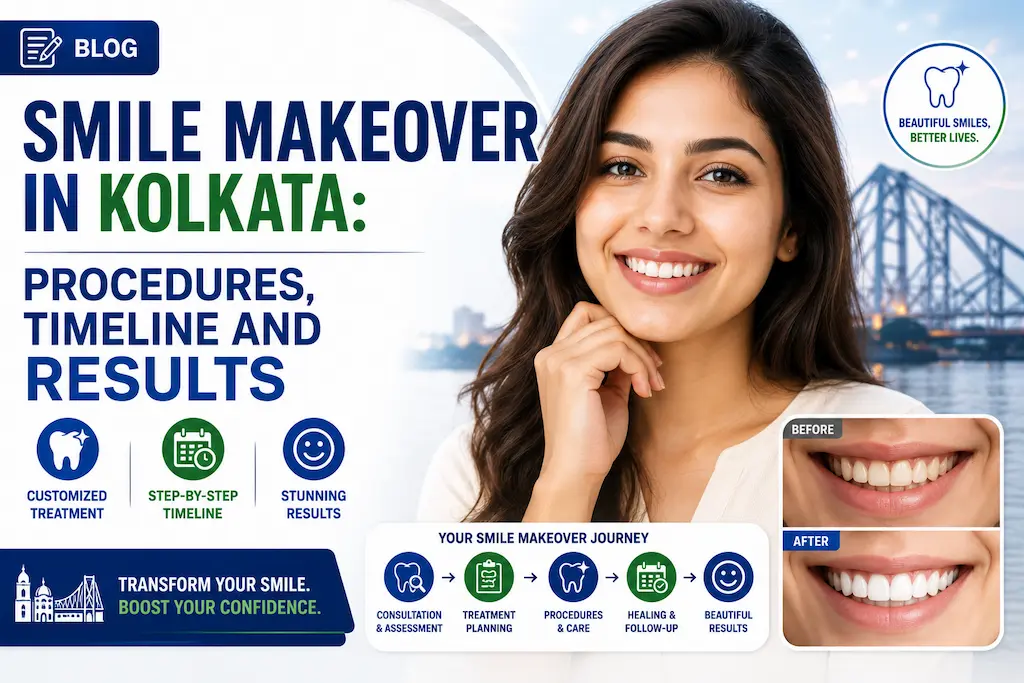
Smile Makeover in Kolkata: Procedures, Timeline and Results
A smile makeover is not a single procedure. It is a personalised plan that combines several cosmetic treatments to improve the colour, shape, alignment and proportion of your teeth. Whether you are preparing for a wedding, a milestone birthday or simply want to feel more confident in photos, a well planned makeover can transform your smile while still looking natural.
This guide walks through what a smile makeover in Kolkata actually involves, the treatments it can include, how long each stage takes, who is a good candidate and what it costs at Teeth Care Multispeciality Dental Clinic.
What this guide covers
What is a smile makeover?
A smile makeover is a combination of cosmetic dental treatments designed around your face, your goals and the current condition of your teeth. Instead of fixing one tooth in isolation, the dentist looks at the whole smile, the shade, the symmetry, the gum line and how everything sits together, and builds a plan to bring it into balance.
Modern makeovers follow a “less is more” philosophy. The aim is a result that still looks like you, only brighter, more even and more polished. Digital smile design lets you preview the outcome before any treatment begins, so there are no surprises.
Treatments a makeover can include
Your plan may use one or several of the treatments below, depending on what your smile needs.
| Treatment | What it corrects | Typical longevity |
|---|---|---|
| Teeth whitening | Yellowing and surface stains from tea, coffee or age | 6 to 18 months with maintenance |
| Porcelain veneers | Shape, shade, chips and gaps | 10 to 15 plus years |
| Composite bonding | Small chips, cracks and minor gaps | 3 to 7 years |
| Gum contouring | Uneven or excessive gum line (gummy smile) | Usually permanent |
| Tooth reshaping | Slightly long, rough or uneven edges | Permanent |
| Clear aligners | Mild to moderate misalignment before finishing touches | Result held with a retainer |
Whitening is often the starting point, and where alignment is a concern, orthodontic treatment such as clear aligners may come first so the final result sits correctly.
Your smile makeover journey, step by step
Step 1
Consultation and digital smile design
Your dentist assesses your teeth, gums and bite, discusses your goals and uses digital smile design to show you a realistic preview of the result. This is where the plan and sequence are agreed.
Step 2
Foundation and alignment
Any health issues are treated first. If teeth need straightening, aligners or braces are done at this stage so the cosmetic work has a stable base.
Step 3
Whitening
Professional whitening sets the base shade, so that veneers or bonding can be matched to a brighter, even colour.
Step 4
Veneers, bonding and contouring
The shaping work is completed with veneers, bonding, gum contouring or reshaping to finish the smile in balance with your face.
Step 5
Review and maintenance
A final review checks the fit and finish. Your dentist explains how to protect the result, including whitening top ups and, where relevant, a retainer.
How long does it take?
Timeline depends on which treatments are in your plan. Use the guide below when planning around an event.
| Time before your event | What is realistic |
|---|---|
| 1 to 2 weeks | Professional whitening, single session results |
| 2 to 4 weeks | Minimal prep veneers, bonding, gum contouring |
| 3 to 6 months | A full makeover combining several treatments |
| 12 to 18 months | Full clear aligner treatment before finishing touches |
Booking your consultation a few weeks ahead of a big day leaves room to preview the result and make calm adjustments rather than rushing.
Are you a good candidate?
Most adults and teens with healthy gums and teeth are suitable after a full evaluation. A makeover is worth considering if you have:
- Yellow or stained teeth that do not respond to home care
- Chips, cracks or worn edges
- Gaps or slightly uneven or crowded teeth
- A gummy smile or uneven gum line
- Old, visible metal fillings you would like replaced with tooth coloured ones
Good to know. Any active decay or gum disease is treated before cosmetic work begins. A healthy foundation is what makes a makeover last.
Smile makeover cost in Kolkata
Because a makeover combines treatments, the total depends on your plan. The indicative figures below help you budget. A precise quote is given after your consultation.
| Treatment | Indicative price |
|---|---|
| Scaling and polishing | From ₹1,500 |
| Teeth whitening or bleaching | From ₹6,500 |
| Veneers (per tooth) | From ₹8,000 |
| Dental crowns | ₹2,500 to ₹12,000 |
Prices are indicative and vary with material, brand, technology and your individual case.
Affordable planning. EMI options are available so you can spread the cost of a full makeover. Ask about EMI during your consultation.
Why choose Teeth Care Dental
- Digital smile design so you preview results before treatment begins
- Advanced laser technology for whitening and gum contouring
- Official Invisalign certified provider for aligner led makeovers
- An award winning clinic, including the International Award of Excellence 2018 in London
- Customised plans built around your event timeline and budget
- Experienced cosmetic dentists across all five Kolkata branches
Treatment is available at all branches: Chinar Park, New Town, Dunlop, Ballygunge and Charnock.
Frequently asked questions
How long does a smile makeover take?
It ranges from a single day for whitening to 2 or 3 weeks for veneers. A full makeover that combines several treatments may span a few months, and cases that need aligners first can take 12 to 18 months.
Is a smile makeover painful?
Most procedures are non invasive or done under local anaesthesia, so discomfort is minimal. Whitening may cause brief, mild sensitivity that settles quickly.
Will it damage my natural teeth?
No. When performed by experienced dentists, modern cosmetic dentistry preserves and protects natural tooth structure. Minimal prep veneers remove very little enamel.
Can I combine whitening and veneers?
Often, yes. Whitening is usually done first to set the base shade, then veneers are matched to it. Your dentist sequences treatments for the best overall result.
Also read
Ready to plan your smile makeover?
Book a consultation and preview your new smile with digital smile design.
Book an appointment Call +91 98315 26251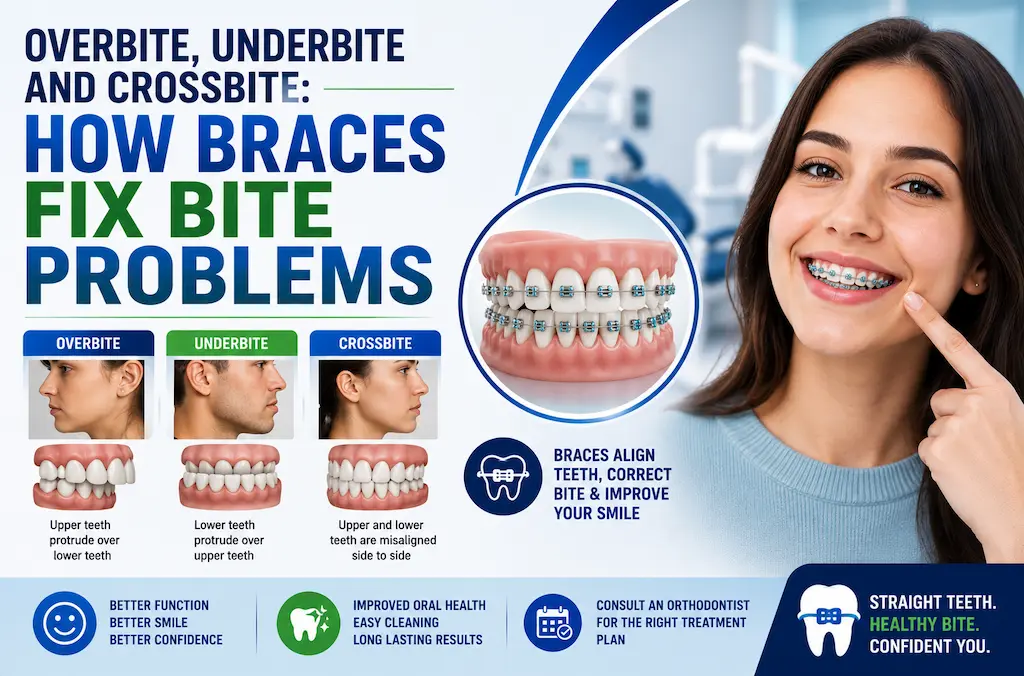
Overbite, Underbite and Crossbite: How Braces Fix Bite Problems
Straight teeth get most of the attention, but how your teeth meet when you close your mouth matters just as much. That meeting point is your bite, and when the upper and lower teeth do not line up correctly, dentists call it a malocclusion. Left untreated, a bad bite can wear teeth down, strain the jaw and make cleaning harder.
The good news is that almost every bite problem can be corrected. This guide explains the common types, why they are worth treating, and how orthodontic treatment at Teeth Care Dental brings your bite back into balance.
What this guide covers
What is a bad bite?
A healthy bite means the upper teeth sit slightly over the lower teeth and the molars meet evenly. When teeth are crowded, spaced or the jaws are out of position, the bite is thrown off. This can be inherited, or it can develop from habits like prolonged thumb sucking, early loss of baby teeth or mouth breathing.
Common bite problems
Overbite
The upper front teeth overlap the lower front teeth too much. A deep overbite can cause the lower teeth to bite into the roof of the mouth and wear the front teeth unevenly.
Underbite
The lower teeth sit in front of the upper teeth. It can affect chewing and speech and often relates to jaw growth, so earlier treatment usually gives better results.
Crossbite
Some upper teeth close inside the lower teeth rather than outside. A crossbite can cause uneven wear and, if untreated, may push the jaw to grow to one side.
Open bite
The upper and lower front teeth do not touch when the back teeth are closed. This makes biting into food difficult and is often linked to thumb sucking or tongue habits.
Crowding and spacing
Too little room leads to overlapping, crooked teeth, while too much room leaves gaps. Both affect the bite and make daily cleaning harder, raising the risk of decay and gum problems.
Why a bad bite is worth treating
Correcting the bite is about far more than looks. Proper alignment helps you:
- Chew and speak comfortably
- Clean teeth more easily, lowering decay and gum disease risk
- Reduce uneven wear on the enamel
- Ease strain on the jaw joints and muscles
- Protect the long term health of every tooth
Left untreated, bite problems tend to get worse with time. Worn, cracked or strained teeth are harder and costlier to fix later than the original alignment issue.
How orthodontics fixes your bite
After a clinical examination and X-rays, your orthodontist designs a plan around your specific bite. Depending on the case, treatment may use:
| Appliance | Where it helps |
|---|---|
| Metal or ceramic braces | Moderate to complex bite correction and crowding |
| Self ligating (Damon) braces | Efficient movement with fewer visits |
| Clear aligners | Mild to moderate cases where discretion matters |
| Growth guidance appliances | Younger patients whose jaws are still developing |
Complex cases often need fixed braces for full control, while milder bites can be corrected with aligners. Your orthodontist will recommend the right approach after assessing your case. Wondering how to judge the right specialist for a tricky bite? Read our guide to the best dentist for braces in Kolkata.
Retention matters. Once the bite is corrected, a retainer holds teeth in their new position. Skipping it lets teeth drift back over time.
The right age to act
Orthodontic care works at any age, and adults make up a growing share of patients. That said, a first assessment by age 7 is ideal, because some bite and jaw issues are far easier to guide while a child is still growing. Our pediatric dentistry team carries out these early checks and refers on for treatment at the right time.
Frequently asked questions
Can a bite problem be fixed without braces?
Mild cases can often be treated with clear aligners. More significant bite issues usually need fixed braces, and some jaw related cases benefit from early growth guidance in children. An examination determines what will work for you.
Is a bad bite only a cosmetic issue?
No. Beyond appearance, an uncorrected bite can cause uneven tooth wear, jaw strain, chewing difficulty and harder cleaning, which raises the risk of decay and gum disease.
How long does bite correction take?
Most treatment ranges from 12 to 24 months depending on the severity of the bite, your age and the appliance used. Milder cases can finish sooner.
Should I bring my child in early?
Yes. A check by age 7 lets the dentist spot developing bite or jaw issues while they are easiest to guide. Not every child needs early treatment, but early monitoring is valuable.
Worried about your bite?
Book a consultation and get a clear assessment and treatment plan from our orthodontist.
Book an appointment Call +91 98315 26251Teeth Care Multispeciality Dental Clinic, Kolkata. Orthodontic treatment at Chinar Park, New Town, Dunlop, Ballygunge and Charnock.
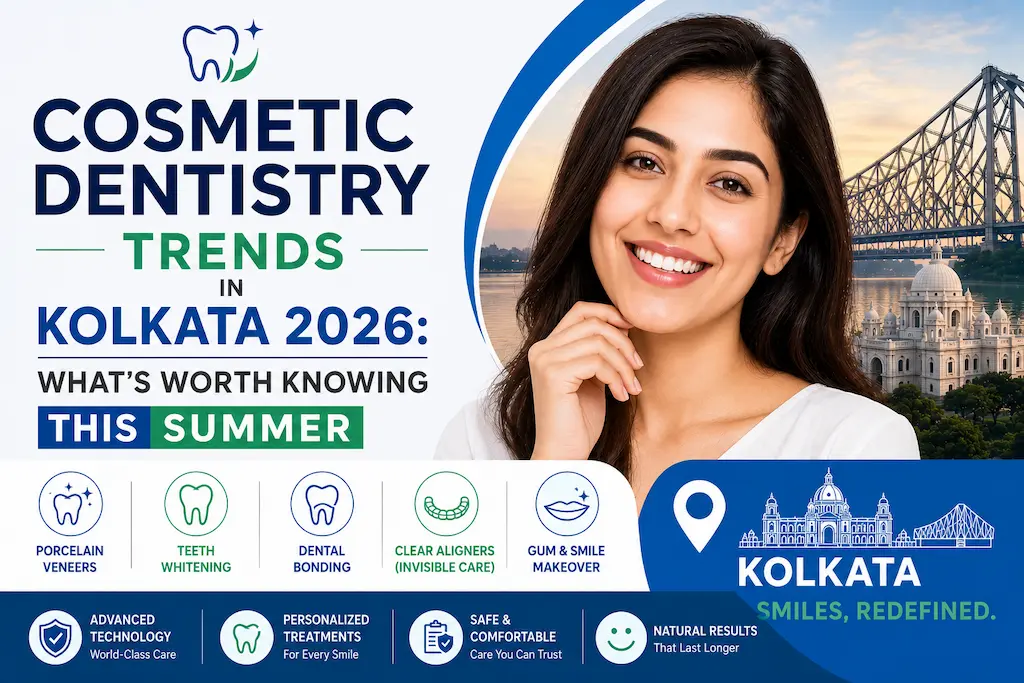
Cosmetic Dentistry Trends in Kolkata 2026: What’s Worth Knowing This Summer
Summer has a way of putting smiles front and centre: weddings, vacations, reunions, graduation photos. If you have been thinking about freshening up your smile before the season’s events arrive, you are far from alone. Cosmetic dentistry in 2026 has shifted toward treatments that look natural, work faster, and ask far less of patients than people often assume.
At Teeth Care Multispeciality Dental Clinic, patients frequently come in during this season asking what their options actually are. This guide walks through what is trending in Kolkata in 2026, what each option involves, and how to plan your timeline so you are camera-ready when it counts.
📋 Table of Contents
The Shift Toward “Less Is More”
One of the biggest changes in cosmetic dentistry is not a specific treatment. It is a philosophy. Rather than dramatic, one-size-fits-all makeovers, today’s approach favours subtle refinements that enhance your natural smile rather than replace it. The goal is a smile that still looks like you, just brighter and more polished.
That shift has fuelled demand for minimally invasive options that preserve as much of your natural tooth structure as possible, supported by digital tools that let you preview your results before committing to anything.
Treatments Patients Are Asking About Most
| Treatment | What It’s Good For | Typical Time |
|---|---|---|
| Minimal-prep veneers | Bright, even smile with little to no enamel removal | 1 to 2 visits |
| Professional whitening | Lifting everyday surface stains for a quick refresh | 30 to 60 minutes |
| Professional bleaching | Lightening the natural tooth shade for dramatic, long-lasting results | 60 to 90 minutes |
| Laser whitening | Fastest, most noticeable brightening under expert supervision | Single session |
| Clear aligners (Invisalign) | Straightening teeth discreetly without metal braces | 12 to 18 months |
| Digital smile design | Previewing your results before any treatment begins | Part of consultation |
| Laser gum contouring | Reshaping an uneven or excess gum line comfortably | Single session, minimal downtime |
A quick look at each:
Minimal-prep veneers
Traditional veneers required removing a noticeable amount of enamel. Newer ultra-thin veneers need little to no tooth reduction, which means a faster, far less invasive process while still delivering a bright, even smile.
Digital smile design
Before committing to anything, digital imaging and design software let your dentist show you a realistic simulation of how veneers, aligners, or whitening will actually look on your smile. No surprises.
Clear aligners
For patients whose main concern is alignment rather than colour or shape, Invisalign remains a discreet, comfortable way to straighten teeth without a mouth full of metal. A popular choice for working professionals in Kolkata.
Laser gum contouring
Where the gum line sits unevenly or covers more of the tooth than it should, laser contouring reshapes it precisely, often with minimal downtime.
Whitening vs Bleaching: Which Should You Choose?
This is one of the most common questions patients bring to a cosmetic consultation, and the two are often confused.
Whitening
Removes surface stains caused by tea, coffee, or smoking. Works best for mild discolouration. A quick, budget-friendly refresh.
Bleaching
Goes further, lightening the natural shade of the tooth itself. Suited to deeper stains or for patients who want a more dramatic change before a big event.
💡 In short: whitening cleans, bleaching changes the shade. Our full breakdown of teeth whitening vs. bleaching walks through the differences, costs, and which is right for different types of stains. If speed matters most, laser teeth whitening delivers the most noticeable results in a single visit. If you are leaning toward bleaching, read the questions to ask your cosmetic dentist first.
Why Timing Matters Before a Big Event
Many cosmetic treatments, including whitening, bleaching, and minimal-prep veneers, can be completed in just one or two visits. Even so, it pays to plan ahead. Booking a consultation a few weeks before your event leaves room to explore your options, preview your results with digital smile design, and make any adjustments calmly rather than at the last minute.
| Time Before Event | What You Can Realistically Plan |
|---|---|
| 1 to 2 weeks | Professional whitening or bleaching, single-session results |
| 2 to 4 weeks | Minimal-prep veneers, laser gum contouring |
| 3 to 6 months | Smile makeover combining multiple treatments |
| 12 to 18 months | Full Invisalign clear aligner treatment |
Why Choose TCMDC for Cosmetic Dentistry in Kolkata
- Digital smile design so you can preview results before treatment begins
- Advanced laser technology for whitening and gum contouring
- Certified Invisalign provider, with access to genuine ClinCheck planning
- Customised treatment plans built around your event timeline and budget
- Experienced cosmetic dentists across all five Kolkata branches
- A multiple award-winning clinic with 19+ years of experience and a 4.9-rated patient track record
Cosmetic treatments available at all 5 branches:
Frequently Asked Questions
How far in advance should I book before an event?
Three to four weeks is a comfortable window for most treatments, enough time for a consultation, the procedure itself, and any touch-ups, without feeling rushed.
Will whitening or bleaching damage my enamel?
No, not when performed by trained professionals using the right concentration and technique. At-home kits without supervision carry more risk.
How long do whitening results last?
Whitening typically lasts three to six months, while bleaching can last one to three years, depending on habits like coffee, tea, and tobacco use.
Can I combine treatments, like whitening and veneers?
Often, yes. A consultation including digital smile design will help your dentist sequence treatments in the way that gives you the best overall result.
Is cosmetic treatment painful?
Most cosmetic procedures involve little to no discomfort. Whitening and bleaching may cause brief, mild sensitivity, and minimal-prep veneers require very little tooth reduction, so recovery is generally straightforward.
📖 Also Read
Book Your Cosmetic Consultation in Kolkata
Curious what your options look like before your next big event? A consultation is the simplest way to find out what is realistic for the smile you have in mind, and how soon you could see results.
Book a Consultation 📞 +91 98315 26251