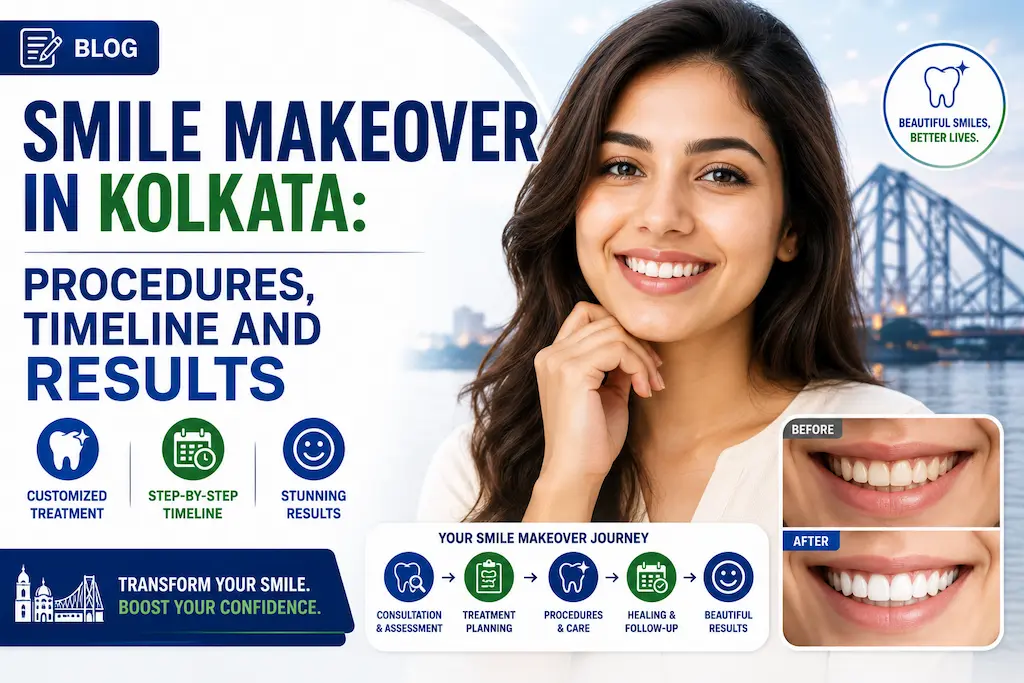
Smile Makeover in Kolkata: Procedures, Timeline and Results

A smile makeover is not a single procedure. It is a personalised plan that combines several cosmetic treatments to improve the colour, shape, alignment and proportion of your teeth. Whether you are preparing for a wedding, a milestone birthday or simply want to feel more confident in photos, a well planned makeover can transform your smile while still looking natural.

This guide walks through what a smile makeover in Kolkata actually involves, the treatments it can include, how long each stage takes, who is a good candidate and what it costs at Teeth Care Multispeciality Dental Clinic.

What is a smile makeover?

A smile makeover is a combination of cosmetic dental treatments designed around your face, your goals and the current condition of your teeth. Instead of fixing one tooth in isolation, the dentist looks at the whole smile, the shade, the symmetry, the gum line and how everything sits together, and builds a plan to bring it into balance.

Modern makeovers follow a “less is more” philosophy. The aim is a result that still looks like you, only brighter, more even and more polished. Digital smile design lets you preview the outcome before any treatment begins, so there are no surprises.

Treatments a makeover can include

Your plan may use one or several of the treatments below, depending on what your smile needs.

TreatmentWhat it correctsTypical longevity
Teeth whiteningYellowing and surface stains from tea, coffee or age6 to 18 months with maintenance
Porcelain veneersShape, shade, chips and gaps10 to 15 plus years
Composite bondingSmall chips, cracks and minor gaps3 to 7 years
Gum contouringUneven or excessive gum line (gummy smile)Usually permanent
Tooth reshapingSlightly long, rough or uneven edgesPermanent
Clear alignersMild to moderate misalignment before finishing touchesResult held with a retainer

Whitening is often the starting point, and where alignment is a concern, orthodontic treatment such as clear aligners may come first so the final result sits correctly.

Your smile makeover journey, step by step

Step 1

Consultation and digital smile design

Your dentist assesses your teeth, gums and bite, discusses your goals and uses digital smile design to show you a realistic preview of the result. This is where the plan and sequence are agreed.

Step 2

Foundation and alignment

Any health issues are treated first. If teeth need straightening, aligners or braces are done at this stage so the cosmetic work has a stable base.

Step 3

Whitening

Professional whitening sets the base shade, so that veneers or bonding can be matched to a brighter, even colour.

Step 4

Veneers, bonding and contouring

The shaping work is completed with veneers, bonding, gum contouring or reshaping to finish the smile in balance with your face.

Step 5

Review and maintenance

A final review checks the fit and finish. Your dentist explains how to protect the result, including whitening top ups and, where relevant, a retainer.

How long does it take?

Timeline depends on which treatments are in your plan. Use the guide below when planning around an event.

Time before your eventWhat is realistic
1 to 2 weeksProfessional whitening, single session results
2 to 4 weeksMinimal prep veneers, bonding, gum contouring
3 to 6 monthsA full makeover combining several treatments
12 to 18 monthsFull clear aligner treatment before finishing touches

Booking your consultation a few weeks ahead of a big day leaves room to preview the result and make calm adjustments rather than rushing.

Are you a good candidate?

Most adults and teens with healthy gums and teeth are suitable after a full evaluation. A makeover is worth considering if you have:

  • Yellow or stained teeth that do not respond to home care
  • Chips, cracks or worn edges
  • Gaps or slightly uneven or crowded teeth
  • A gummy smile or uneven gum line
  • Old, visible metal fillings you would like replaced with tooth coloured ones
Good to know. Any active decay or gum disease is treated before cosmetic work begins. A healthy foundation is what makes a makeover last.

Smile makeover cost in Kolkata

Because a makeover combines treatments, the total depends on your plan. The indicative figures below help you budget. A precise quote is given after your consultation.

TreatmentIndicative price
Scaling and polishingFrom ₹1,500
Teeth whitening or bleachingFrom ₹6,500
Veneers (per tooth)From ₹8,000
Dental crowns₹2,500 to ₹12,000

Prices are indicative and vary with material, brand, technology and your individual case.

Affordable planning. EMI options are available so you can spread the cost of a full makeover. Ask about EMI during your consultation.

Why choose Teeth Care Dental

  • Digital smile design so you preview results before treatment begins
  • Advanced laser technology for whitening and gum contouring
  • Official Invisalign certified provider for aligner led makeovers
  • An award winning clinic, including the International Award of Excellence 2018 in London
  • Customised plans built around your event timeline and budget
  • Experienced cosmetic dentists across all five Kolkata branches

Treatment is available at all branches: Chinar Park, New Town, Dunlop, Ballygunge and Charnock.

Frequently asked questions

How long does a smile makeover take?

It ranges from a single day for whitening to 2 or 3 weeks for veneers. A full makeover that combines several treatments may span a few months, and cases that need aligners first can take 12 to 18 months.

Most procedures are non invasive or done under local anaesthesia, so discomfort is minimal. Whitening may cause brief, mild sensitivity that settles quickly.

No. When performed by experienced dentists, modern cosmetic dentistry preserves and protects natural tooth structure. Minimal prep veneers remove very little enamel.

Often, yes. Whitening is usually done first to set the base shade, then veneers are matched to it. Your dentist sequences treatments for the best overall result.

Ready to plan your smile makeover?

Book a consultation and preview your new smile with digital smile design.

Book an appointment Call +91 98315 26251
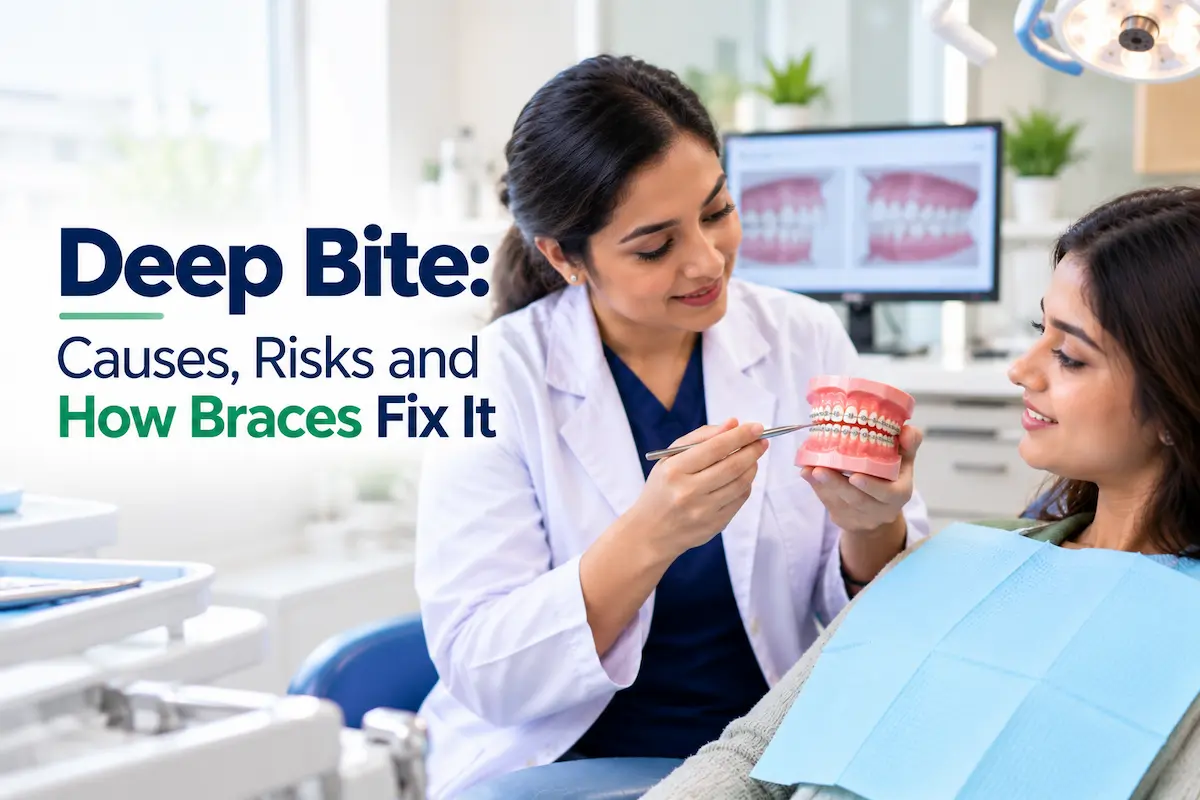
Deep Bite: Causes, Risks and How Braces Fix It

Smile in front of a mirror and look closely at your front teeth. In most people, the upper front teeth overlap the lower ones a little. Now imagine the lower front teeth almost disappearing behind the upper ones, or biting into the gum on the roof of your mouth. That is a deep bite, and many people live with it for years without knowing it has a name.

It rarely hurts at first, which is why it gets ignored. Over time, though, it can wear down teeth and damage the gums behind them. This guide explains what it is, how to tell if you have one, what causes it, and the deep bite treatment options orthodontists use for children and adults.

What Is a Deep Bite?

A deep bite, also called an excessive overbite, is one where the upper front teeth cover the lower front teeth too much vertically. The American Association of Orthodontists describes it as a type of malocclusion, which simply means the teeth do not meet the way they should.

Some overlap is normal. Orthodontic teaching material commonly treats a vertical overlap of more than 4 mm, or lower teeth that touch the back of the upper front teeth near the gum, as excessive. In the most severe form, sometimes called a traumatic or impinging bite, the lower front teeth actually bite into the gum on the roof of the mouth.

Deep bite is not the same as buck teeth. It is about vertical overlap, how far the upper teeth come down over the lower ones. Teeth that stick out forward are a different problem called overjet. Many people have both, which is why an orthodontist measures each separately.

If you are trying to work out which bite problem you have in general, our main clinic site has a detailed guide to overbite, underbite, crossbite and open bite. This article focuses on vertical overlap specifically.

Signs You May Have a Deep Bite

Only an orthodontic examination can confirm it, but these are common signs worth mentioning at your visit:

  • When you bite together, you can barely see your lower front teeth
  • Sore spots or marks on the gum behind your upper front teeth
  • Lower front teeth that look worn, short or chipped
  • Gum recession behind the upper front teeth or in front of the lower ones
  • Discomfort around the jaw

What Causes a Deep Bite?

Orthodontists usually group the causes into three types, and the type decides the treatment.

Type 1

Dental causes

Front teeth that have over-erupted, back teeth that are short or worn, missing or tipped back teeth, gum disease and tooth wear can all let the bite close too far.

Type 2

Skeletal causes

The way the jaws grow can create a deep bite, for example when the lower jaw rotates forward and upward as it grows, or when the jaw bones are not in proportion.

Type 3

Muscular causes

Very strong chewing muscles can press the bite closed over time. Tooth grinding can make the problem worse in adults.

Missing or tipped back teeth, one of the dental causes above, can let the bite close further. If you have gaps at the back of your mouth, ask about replacing them as part of your plan.

Why a Deep Bite Is Worth Treating

The AAO lists several problems it can cause, and notes that it usually does not correct itself.

ProblemWhat happens
Tooth wearFront teeth, especially the back surface of the upper ones, wear down early
Gum damageLower teeth press on the gums behind the upper teeth, which can cause recession
Painful soresSores can form on the roof of the mouth where the lower teeth bite
ChippingFront teeth are more likely to chip
Jaw discomfortSome people feel discomfort around the jaw joint
CrowdingIt can make crowding or spacing worse
Planning crowns or veneers? Get your bite checked first. Because this kind of bite can wear and chip front teeth, correcting it beforehand helps protect cosmetic work.

Deep Bite Treatment Options

Orthodontist in Kolkata holding braces models used for deep bite treatment

Deep bite correction depends on the cause, your age and how severe the overlap is. These are the main approaches orthodontists use, often in combination:

Option 1

Fixed braces

The most common treatment, according to the AAO. Specially shaped wires gradually level the bite by moving front teeth up into the bone (intrusion), letting back teeth come down, or both. Our orthodontic treatment page lists every type of brace we offer.

Option 2

Clear aligners

Custom removable trays can correct many cases when they are worn for the hours prescribed. Your orthodontist will tell you honestly if your bite is better suited to fixed braces. Read more about clear aligners and Invisalign in Kolkata.

Option 3

Bite turbos (bite ramps)

Small bumps of tooth-coloured material placed on the teeth that stop the bite closing fully while the braces work. They are temporary and removed once the bite opens.

Option 4

Mini-screws (TADs)

Tiny temporary screws placed in the bone give the orthodontist a fixed anchor to push front teeth upward. A 2026 review of 26 studies on adult deep bites found two mini-screws placed beside the lateral incisors achieved the most intrusion.

Option 5

Jaw surgery for severe skeletal cases

When the jaw bones themselves cause a severe overlap and growth has finished, the AAO notes that surgical orthodontics may be needed alongside braces.

The same 2026 review notes a trade-off: most ways of pushing front teeth upward also tip them forward a little, and some root shortening was seen across all intrusion methods. That is why deep bite correction needs careful planning and regular monitoring by an orthodontist. Our article on orthodontist vs dentist explains why specialist training matters for cases like this.

Deep Bite in Children vs Adults

Children and teens
  • Jaws are still growing, so growth can be guided
  • Functional appliances may be used in some cases
  • Early check-ups help spot skeletal causes in time
  • See our guide on early orthodontic evaluation
Adults
  • Growth has stopped, so teeth are moved rather than jaws guided
  • Braces, aligners, bite turbos and mini-screws are all used
  • Missing back teeth may need replacing as part of the plan
  • See our guide on adult orthodontic treatment

Adults often ask if it is too late. It is not. The approach is different from a child’s, and the AAO lists braces, clear aligners and, for severe skeletal cases, surgery as options once growth has finished.

Keeping the Result

Once the bite is level, it needs holding there while the bone and gums settle. That means wearing a retainer exactly as your orthodontist prescribes. Our guide to retainers after braces explains the types and how long to wear them.

If you grind your teeth at night, mention it. Grinding can push a corrected bite closed again, and your orthodontist may suggest a night guard as well.

References

Frequently Asked Questions

What is a deep bite?

A deep bite, or excessive overbite, is when the upper front teeth cover the lower front teeth too much vertically. Orthodontic teaching commonly treats more than 4 mm of overlap as excessive.

It often causes no pain at first, but it can wear down teeth, damage the gums behind the front teeth and cause sores on the roof of the mouth. The AAO notes that a deep bite usually does not correct itself.

Mild cases can sometimes be corrected with clear aligners. Severe skeletal cases in adults may need jaw surgery along with braces. Your orthodontist will recommend the option that suits your bite.

It depends on the cause and severity. Deep bite correction is usually part of a full orthodontic treatment, so your orthodontist will give you a timeline after examining you.

Yes. Adults are treated with braces, aligners, bite turbos and sometimes mini-screws. Severe skeletal cases may need surgery once growth has finished.

No. A deep bite is about vertical overlap. Teeth that stick out forward are called overjet. Many people have both, so an orthodontist measures them separately.

Think You Might Have a Deep Bite?

Book an orthodontic consultation at any Teeth Care branch in Kolkata. We will measure your bite and explain the options that suit it.

Book an AppointmentCall +91 98315 26251

Available at our Chinar Park, New Town, Ballygunge, Dunlop and Charnock branches. This article is for general information and does not replace a clinical examination.